

A Fear-Mongering Law for Locking up Disabled People Falls Apart in New York
Will lawmakers reauthorize Kendra's Law when the state "buried" a report showing it doesn't work?


.jpg)
Listen to an audio version of this week’s edition of (Un)Hidden here.
A few weeks ago I wrote an op-ed for The Boston Globe about a mental health bill in the Massachusetts legislature that would have empowered courts, psychiatrists, and others to force mentally ill people to take medication and accept services. These laws, called Involuntary Outpatient Commitment (or, to their supporters Assisted Outpatient Treatment) exist all over the country with little proof that they work and growing evidence that they do not.
As I wrote, a similarly flawed law from a century ago allowing for the permanent incarceration of so-called “defective delinquents” serves as a warning that these kinds of coercive ways of addressing mental illness are often badly conceived. They target disabilities they cannot actually define with any accuracy—“serious mental illness,” “severe mental illness,” and “grave disability” to name a few—and they are of questionable effectiveness even when applied in the rare instances where people are both physically violent because of their mental illness and also refuse all means of voluntary treatment.
Thanks to the work of a large coalition, your outreach, and the op-ed, the Massachusetts bill died in the current session of the legislature on Saturday.
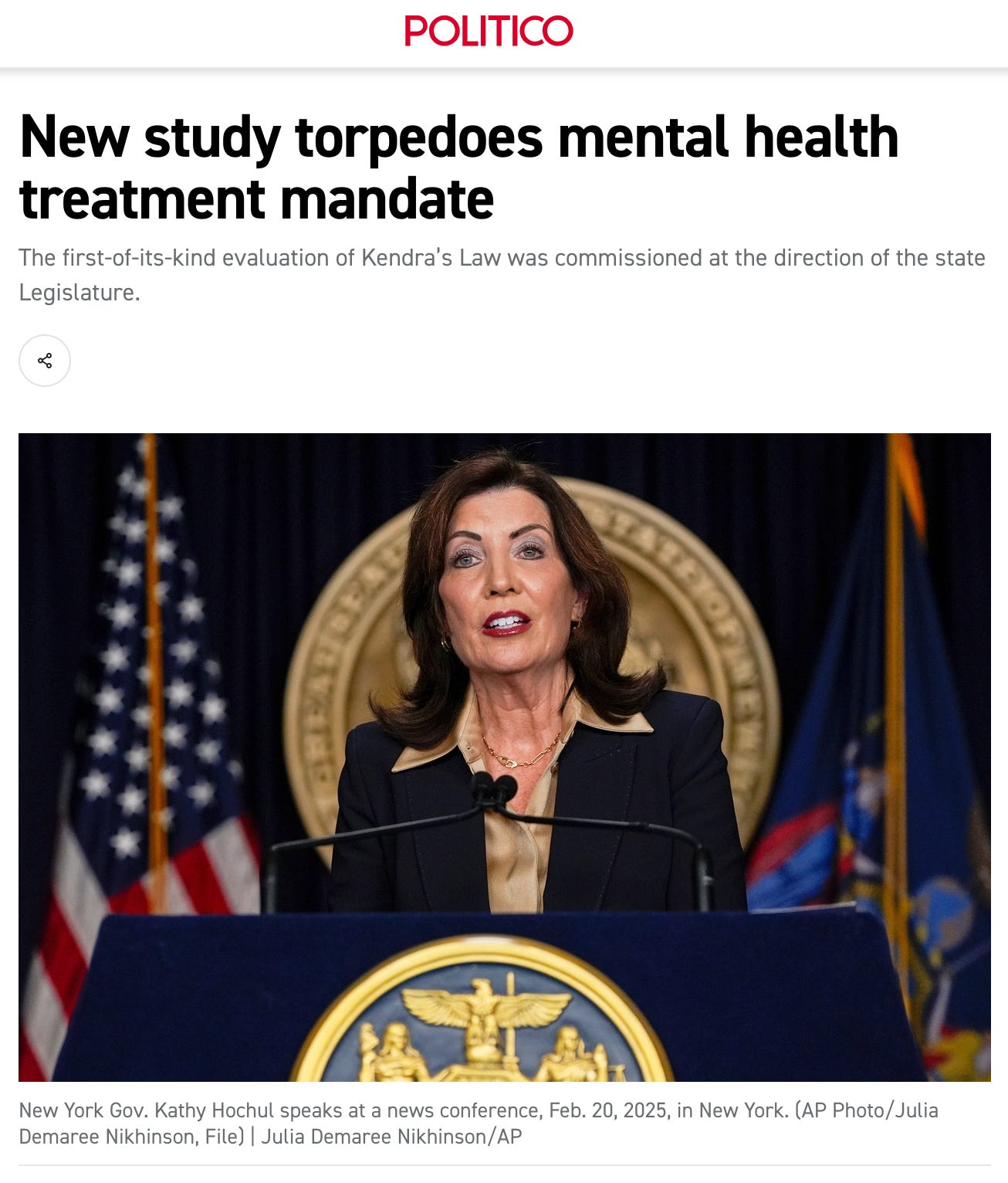
But this was never just about Massachusetts, which was a target for the bill’s backers in part because they are doing a giant box-checking exercise. Indeed, nearly every other state has an involuntary outpatient commitment law on the books. Today, Politico provided a damning update on how things are going in one of them, revealing that the New York State Office of Mental Health “buried” a 400-page study of the state’s own involuntary outpatient commitment law because it “torpedoes” the entire premise that this massive, costly judicial-medical erosion of disabled peoples’ rights delivers on its most basic promises.
Known as Kendra’s Law, New York’s policy was a much-publicized attempt by Governor Kathy Hochul to do exactly what the Massachusetts law proposed to do. When the state legislature granted her the authority to enact the law, it did so on one condition. Because it is such a drastic infringement on fundamental human rights, the legislature ordered the state to conduct a study before any request to reauthorize it in 2027 can be considered.
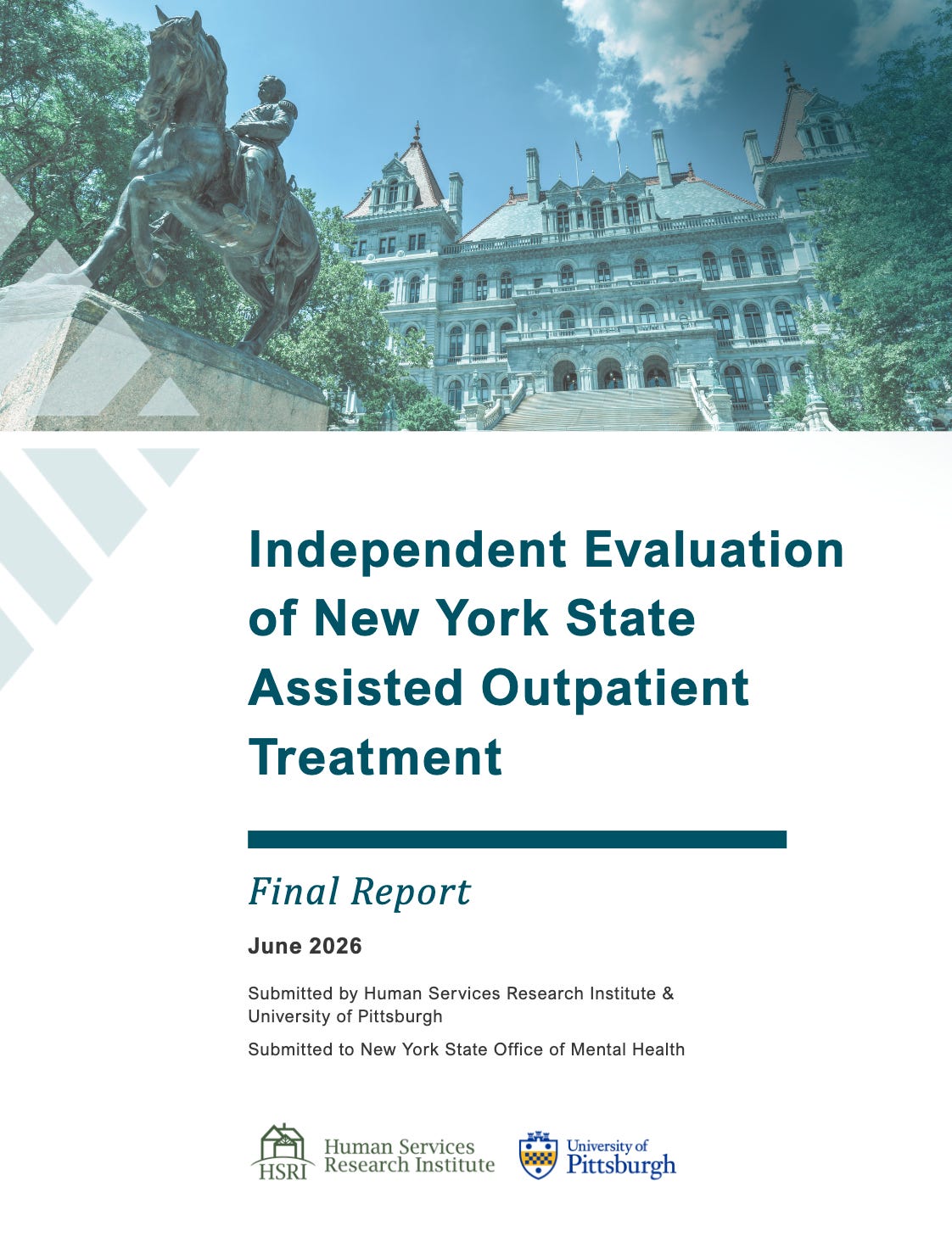
Written by two of the most reputable research organizations on disability policy—the University of Pittsburgh and the Human Services Research Institute the study compared the outcomes for voluntary and involuntary treatment alike.
On the crucial issue that draws the most mob-like fearmongering—crime by mentally ill people—it was a wash. On one hand, the study found that people who were violent saw substantial benefits from involuntary treatment compared with voluntary treatment. But it also found that people with arrest records did substantially better under voluntary treatment than involuntary treatment.
On a host of other issues, from transportation to housing and health care, the study’s authors noted that coercive treatment works no better than voluntary treatment and the only reason that it works at all is because it use services that are available voluntarily but far too inaccessible for people to know about and access. The result is that the authors of the report rightly call for expanding access and awareness to voluntary services in lieu of having to resort to arresting disabled people and dragging them into a lifetime of court-ordered monitoring just to let them know those programs exist.
Just keyword surfing through the report begins to show that the law has the kind of traumatizing impact on disabled people that will reverberate in damaging ways over time, leading them to grow increasingly resistant to future services and supports, which is an outcome others have found when looking into these programs nationwide.
The word “fear” shows up 24 times in the report. “Coercion” and related words show up more than 124 times. But it goes much deeper than that.
As I wrote in the Boston Globe, these laws are so badly written, they cannot actually be used to identify a real group of disabled people, which means they are often used against people for whom there is no actual legal authority to impose treatment, or where the methods being used are doomed to fail even before we get to the matter of basic human rights. At the same time, I wrote that history shows how little oversight and accountability there is within these kinds of processes, which are then ripe for abuse and malpractice by authority figures.
Of the many findings in New York’s report, three demonstrate these kinds of failures.
The first is the following admission from a state administrator:
“Sometimes we have referrals that are predominantly substance abuse. Just a marginal psychiatric kind of layer to that. That usually happens when they get admitted to a hospital in an intoxicated state, but they get a label of a psychiatric diagnosis in the process. And then that sort of carries them. But really, the bulk of the issues are really substance abuse-related. And so that individual is not likely to do as well with the court order or care about a court order.”
This means that a population of people are trapped in a process that was not intended for them while at the same time, they are deprived of the services they need. As the report notes, while these people are being forced into treatment intended for people with other forms of so-called “serious mental illness,” there are, “potential missed opportunities to connect people to recovery-oriented services.”
Equally upsetting is the fact that state administrators, psychiatrists, and other study participants shared that involuntary outpatient treatment appears to inflict particular harm on mentally ill people who are also intellectually disabled. These intellectually disabled individuals appear to fare badly because, as one state administrator said, their disability prevents them from actually following the requirements of court orders.
In turn, this means that intellectually disabled people with mental illness are more likely to be subjected to severe punishments like incarceration, solely because the system absurdly fails to recognize the widely understood, extraordinarily basic point that a person can have more than one disability at once.
As with substance abuse disorder, this also means that people with intellectual disabilities are not getting voluntary services that might prove effective and would mitigate the need to use involuntary and coercive methods.
Why don’t they get them?
Because they cannot even get a diagnosis, let alone the supports. The report suggests that there is widespread concern throughout the involuntary outpatient commitment system that many people caught up in it have undiagnosed intellectual disabilities. As one administrator told the researchers, “It’s easier to get into Harvard than to get [testing and state disability] services.”
This backdrop—where people who the law was never intended to deal with are now caught up in it—makes a particular number in the report all-the-more disturbing. Researchers found that 95% of applications for involuntary treatment in New York “are uncontested.” What this means is that the purportedly thorough process of having the court, a doctor, and others evaluate a person from the outset are almost always approved even though the two earlier points show that they are not properly recognizing the disabilities of the people they are committing.
This is an alarming prospect. The number is so high that it raises basic questions about whether disabled people who are hauled in under this law have any real ability to exercise their right to due process and get a fair hearing. It also raises the question of whether there is any effective oversight or accountability built into the commitment process.
After all, if administrators are saying that they are seeing a notable number of people who have been committed under this law but do not meet the criteria, or would benefit from voluntary services they have not been made aware of, how can 95% of applications be approved without it being evidence that the people implementing the law are not doing an effective job?
Given the longstanding track record of state abuses of mentally disabled people, this suggests that the system will be—and likely already is—plagued by staff-based abuse of outpatient inmates that are common in other disability-based systems that are imposed on disabled people by force.
It comes full circle. Laws like this simply re-hash failed policies of the past and people learn that they fail on the backs of the disabled people who are abused by this impulsive and willfully ignorant cycle of oppression.
Make no mistake, involuntary outpatient commitment is a policy failure that also has no party affiliation. Democratic and Republican governors and legislators have pushed sensational stories about violence by mentally ill people and linked it, without evidence, to policies that inflict increasingly violent state repression on disabled people.
It is part of the larger bi-partisan wave toward re-segregation and abuse of disabled people not seen in decades. As with so many laws designed to address unsubstantiated fear, often driven by singular instances that are blown up by the media, these laws fail everyone, which is something lawmakers and leaders can address by finding the minimal amount of moral courage it would take to refuse to pass them where they do not yet exist and repealing them where they do.