

AI, College, and Disability
Thoughts on Disabling Technologies in the Wall Street Journal


In my op-ed in today’s Wall Street Journal—“AI Robs My Students of the Ability to Think”—I write that, “For all its promise, AI is being developed and used in ways that are disabling.”
This idea—that technology can cause disability—is as frequently overshadowed as it is rampant in our time. But not that long ago, disabled people and our allies were thinking about these very things (and indeed some are doing so today). In the 1977 book Disabling Professions, co-author Ivan Illich described a coming “descent into technofascism” that would be the cause and result of “impoverishing wealth.”
Central to Illich’s fears was the idea that disability is not just biological but is also created by systems like the one we are now living in.
Technological revolutions hide their extreme destructive qualities behind the rosy language of the unprecedented and the promise of even more. I can write that statement for the same reason that thinkers like Illich could see these things coming: because they have happened before.
Indeed, one way to interpret the early 20th century rise of new medical tools of intellectual oppression like the I.Q. test (and new definitions like “moron” and “defective delinquency”) that I chronicle in my biography of Walter Fernald is to see them as the kind of disabling technofascism Illich describes.
This is why, when I share stories of the former institutional inmates of “state schools” with people and they ask what a given person’s disability was, I often reply, “the only disability I’m certain they have is the one of having been institutionalized.”
The tests and terms that created the tragedy of killing and institutionalizing intellectually disabled people came with the same salesmanship we see with today’s technology, including fervent promises of a coming utopia that necessitate funneling large amounts of public funds into private hands. For instance, back then, cities and states spent fortunes on I.Q. tests printed by private publishers.
The same was true a generation earlier when cities and towns passed Ugly Laws to keep the disabled off their streets, all because they did not like people whose visual presence undermined their narrative of (pre- and) post-Civil War industrialization.
But the era of the I.Q. test and its mass redefinition of intellectual disability is the vastly more important and potent example because the networks of behavior its champions modeled and honed were set deep into institutions—not just ones they used to detain and kill disabled people—but the ones I call out in my op-ed.
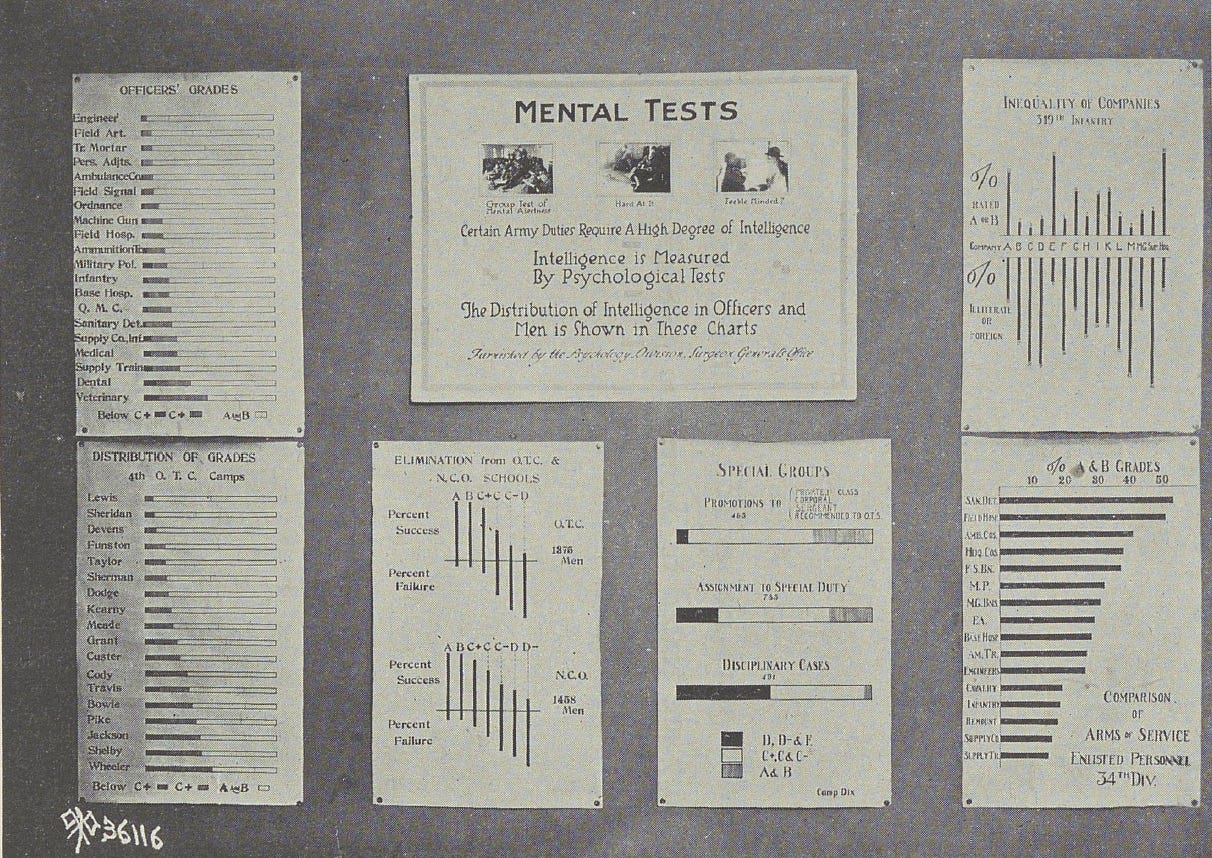
Specifically, they created a class of technocratic university professors out of social psychologists, and these men and women transformed higher education in ways that reverberate. Today, their analogues are the evangelists for AI who think they have earned the relief that only it can provide, by doing central aspects of teaching on their behalf, from grading assignments to giving feedback.
Drawing these connections does not take a giant wall map with string and connected data points. Look no further than Stanford University where I.Q. test pioneer (and financial beneficiary) Lewis Terman held a prized position for decades (I’ll write more about him soon). Terman’s academically fraudulent practices set an example for marrying the functions of universities to those of private industry and government in pursuit of ‘solving” purported problems over such scale and time that accountability was never possible.
In Terman’s case, a confluence of ample support and funding from private and public sources alike allowed him to propagandize the fear that people he defined as geniuses were being held back by people people he defined as stupid. His cause was the technofascist proposal of wiping out the stupid ones to save democracy.
His ideas have terrorized generations of innocent people since, but his playbook was emulated by his son, Frederick Terman, who became the Father of Silicon Valley, and whose evangelism for the promise of technology at the hidden expense of the vulnerable are so embedded in our society that they are simply routine today.
While many of these things pass through the pages my book, they are also the unspoken backdrop to the piece in today’s Wall Street Journal which I hope you will read and share via this post. The first three paragraphs are below, with a link to click for the rest of the piece.
“One of the things I love about teaching political communications is my students’ eagerness to take up the art and craft of the work at hand. Shame seldom cast its shadow on our classroom conversations. Last year that changed.
“More than half the nonnative English-speaking students and a notable number of native English speakers told me that after relying on AI to draft their papers and emails, their ability to write, speak and conduct basic inquiry is slipping away. They tell me this as if they have done something wrong, never considering that it is their professors, not they, who should carry that burden.
“I am no stranger to the effect of technology on language and literacy, nor am I shocked by its bland patterns of enthusiastic advent, which always give way to shabbiness and decay. Google promised the ability to search—a word that has terrific depth and meaning—and delivered a crass advertiser-led sorting system. Facebook started as proto-Tinder before a revamp that said we’d get Woodstock-style digital communes. Then it locked us in a space where people scream at each other.
To keep reading, CLICK HERE.
To learn more about A Perfect Turmoil: Walter E. Fernald and the Struggle to Care for America’s Disabled, read on here.